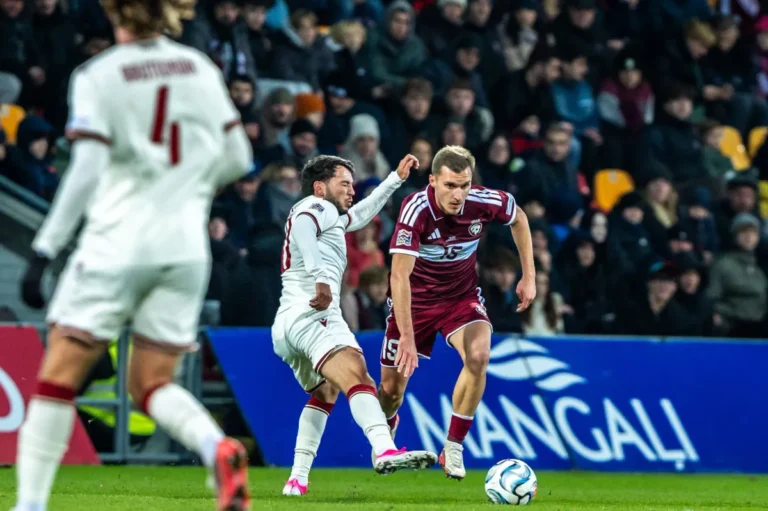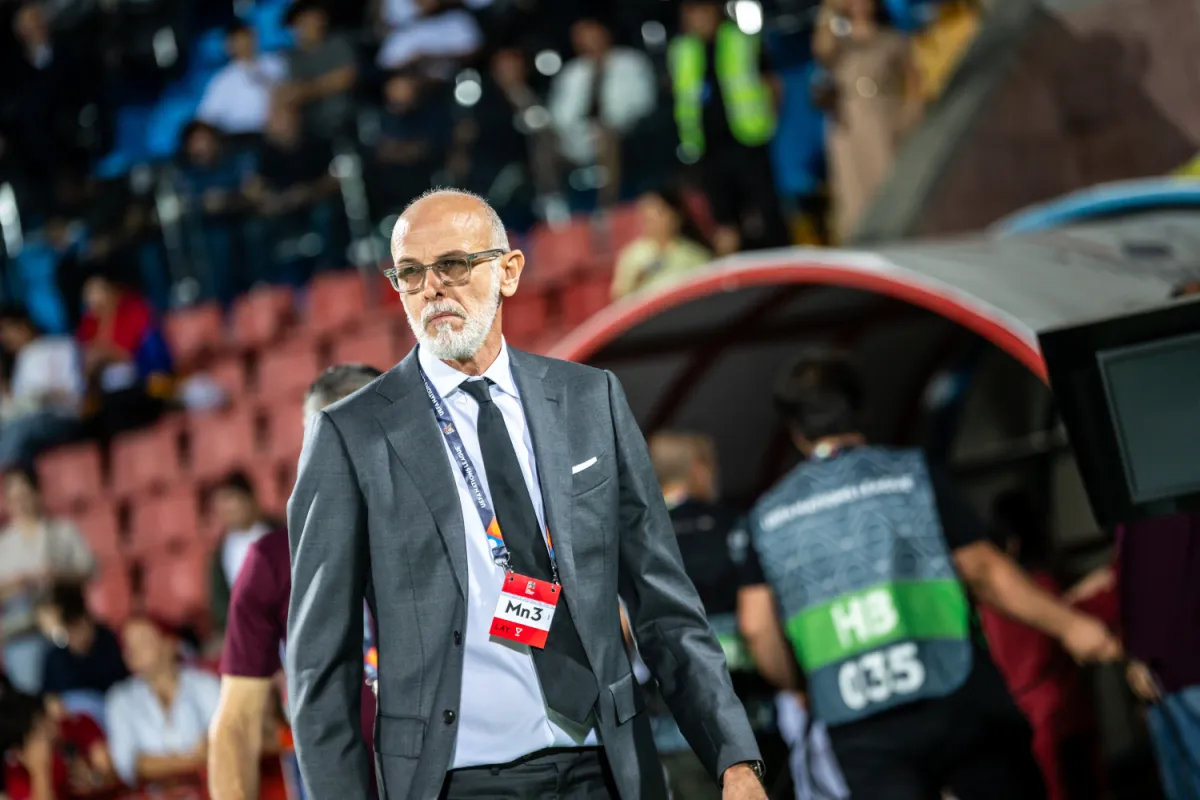
The head coach of the Latvian national football team, Paolo Nicolato, has firmly defended his choice to maintain an attacking formation with two strikers during the closing moments of their one-two defeat against Montenegro. The Italian manager insisted that he harbors no regrets about taking significant tactical risks in their quest to secure a victory. In statements made to Edmunds Novickis, a journalist for Sportacentrs.com, as well as to Baltic Football News ahead of Sunday’s concluding UEFA Nations League fixture facing Armenia, the head coach additionally disclosed fresh medical concerns regarding his squad and hinted that only minimal adjustments will likely be made to his starting lineup.
Latvia approaches this final Nations League encounter on the heels of a painful loss in Podgorica. In that match, the team conceded a decisive goal during stoppage time despite holding a numerical advantage on the pitch for a duration exceeding half an hour. Nonetheless, Nicolato stays thoroughly convinced that the recent displays by his team illustrate substantial overall progress, even if the final scorelines have consistently failed to reflect those positive steps.
While looking back at the final moments of the fixture against Montenegro, the Italian manager revealed that his tactical review demonstrated that the home team had generated scoring opportunities valued at approximately two expected goals, commonly known as xG, throughout just the last eight minutes of regulation.
Nicolato pointed to his players’ strong psychological drive to claim all three available points, rather than content themselves with securing a draw, as the primary root cause behind their late defensive vulnerabilities.
Nicolato explained that they genuinely wanted to win the match. He noted that even after Montenegro managed to equalize the score, the team still felt strongly that they could go on to win the game. He added that they consequently lost some of their defensive structure and tactical balance, which unfortunately paved the way for opponent counter-attacks and dangerous set pieces. In his view, this breakdown occurred because the players were entirely focused on winning and showed a willingness to accept maximum risks to achieve that goal.
The head coach for Latvia readily conceded that his squad lacked sufficient experience in successfully managing such high-pressure scenarios. However, he maintained firmly that the overall team display delivered over the opening eighty-five minutes of the contest had been deeply encouraging.
According to Nicolato’s assessment, Montenegro proved to be a formidable adversary when measured by individual player quality, tactical concepts, and overall structural organization. This high caliber of the opponent made Latvia’s performance on the field particularly gratifying, regardless of the unfortunate outcome at the final whistle.
Furthermore, the Italian tactician defended his strategic decision to deploy two simultaneous strikers after shifting his team into a four-four-two formation as the second half progressed.
He stated that at that specific juncture, he truly believed they were making the correct choice. He pointed out that they had already equalized and possessed an extra player on the pitch, leading him to conclude that taking risks was necessary to pursue the win. He reasoned that introducing another defender would have communicated the incorrect message to his squad, and he reiterated that he holds zero regrets regarding that choice.
Nicolato openly admitted that Latvia did forfeit a degree of tactical balance during this phase, but he placed strong emphasis on the fact that raw emotions, rather than the formation itself, played a major role in creating those defensive difficulties.
Turning to the team’s health ahead of the Armenia clash, Latvia faces the distinct possibility of being without the services of Deniss Meļņiks for Sunday’s fixture. The defender has encountered unexpected health complications over the preceding two days.
Nicolato revealed that Meļņiks is currently undergoing thorough medical examinations, and he candidly noted that the probability of him being match-fit and available for selection is not very high.
In addition, Markuss Strods is not currently operating at full fitness, though the members of the coaching staff remain hopeful that he will manage to recover in time to contribute. Conversely, Maksims Toņiševs has successfully rejoined the active squad after being forced to sit out the previous match against Montenegro, while the rest of the roster remains generally fit and available.
Even though Latvia has little remaining to play for regarding their ultimate final position within the group standings, Nicolato stated he has no intentions of implementing sweeping, wholesale changes to his team.
He expressed his belief that they will require a few adjustments for the upcoming match, but stressed that the number will be small. He noted that the team is currently functioning well, and that this positive assessment applies not merely to their most recent outing, but equally to their preceding performances throughout this current international window.
The head coach intimated that two or three changes to the starting eleven remain entirely possible, primarily driven by the demanding physical requirements needed to sustain a high level of intensity across entire matches.
Nevertheless, he made his stance explicitly clear by stating that he possesses no desire to drastically alter either the established team formation or the personnel tasked with executing it.
Shifting his focus to the left side of the pitch, Nicolato praised the developing partnership forged between Oskars Vientiess, Denniss Cirkins, and Andrejs Cigaņiks. When asked if he would opt for a different starting lineup for the opening Nations League defeat against Armenia in hindsight, the Italian explained that his initial strategy relied heavily on the absolute necessity for defensive compactness and veteran experience. However, the subsequent impressive displays delivered by younger squad members ultimately motivated him to embrace a more aggressively minded tactical framework.
Nicolato reaffirmed his view that he considers Cirkins to be most naturally suited to the full-back position, while simultaneously acknowledging the player’s impressive tactical versatility further up the field.
He offered particularly glowing praise concerning the blossoming partnership developing between Cirkins and Cigaņiks along Latvia’s left flank.
He stated that the on-field connection linking Cirkins and Cigaņiks on the left side functions extremely well. He voiced his happiness with this specific partnership and stated his desire to leave it unchanged if circumstances permit.
The head manager also addressed the specific tactical choice to substitute team captain Antonijs Černomordijs when Latvia transitioned to a defensive line consisting of four players during the Montenegro fixture.
Nicolato explained that operating with a pairing of two central defenders demands distinct physical traits, with raw pace being chief among them, and suggested that Černomordijs is fundamentally better suited to anchoring a back three at this tier of international competition.
Despite this tactical shift, he offered high praise for the captain’s individual display on the pitch and maintained that removing him was purely a tactical decision rather than any indictment of poor play.
Nicolato then addressed the individual displays of two established Latvian attacking figures, namely Jānis Ikaunieks and Eduards Dašķevičs.
Ikaunieks made his return to the national team setup during the current month after being absent from the previous international window in September, but he unfortunately struggled to exert his usual influence against Montenegro.
Nicolato admitted that perhaps Jānis is not currently operating at his absolute peak form. He noted that the player failed to exhibit his customary level of performance because the coaching staff knows well that he is a talented footballer, while simultaneously clarifying that he had no intention of casting blame on any single individual.
Regarding Dašķevičs, the Italian manager firmly dismissed any notion that substituting the winger pointed to a lack of faith in his capabilities. Nicolato stated that he completely agrees that Dašķevičs counts among their finest players, adding that he harbors absolute zero doubts concerning that fact.
The coach elaborated by explaining that the intensely energetic playing style favored by Dašķevičs can occasionally complicate his ability to maintain that exact same physical intensity across the duration of an entire ninety-minute match.
He noted that the player invariably gives one hundred percent effort on the pitch, though he sometimes struggles to properly manage his expended energy throughout the contest, often trying to execute every action at maximum speed which leaves him virtually no time to recover his breath.
Nicolato concluded this thought by noting that possessing viable tactical alternatives on the substitutes’ bench currently grants him the necessary flexibility to withdraw players when their physical output begins to dip.
Defensive frailties during set pieces continue to represent an ongoing area of tactical concern for the team. Latvia has conceded damaging goals originating from corner kicks in matches against both Armenia and Montenegro, yet Nicolato firmly believes these defensive lapses stem more from individual duels within the box than from any fundamental flaws in overall defensive organization.
He argued that his players generally occupied the correct spatial positions during these dead-ball scenarios, but were simply outmatched by physically superior opponents. The Italian drew attention to the inherent quality present within Montenegro’s attacking ranks, observing directly that several of their players regularly compete and score goals within the competitive environment of Italy’s Serie A.
He explained that during these intensely physical encounters, the team is occasionally not fully prepared. He stated that they lack ultimate strength, raw power, and sharpness, which periodically leads to losing crucial individual duels at this elevated level of play.
Regardless of these specific shortcomings, Nicolato maintained his assertion that Latvia’s macro-level defensive organization throughout the Montenegro match remained solid.
Even in the wake of yet another heartbreaking late defeat, Nicolato insisted that the overarching internal atmosphere maintained within the Latvian squad remains surprisingly upbeat and positive.
The head coach revealed that he has drawn great encouragement from observing the general mood during the team’s latest gatherings, noting that the players themselves clearly recognize the tangible improvements visible in their match displays.
He stated that the players are completely cognizant of their ongoing team progress alongside the high quality of their performances, adding that they genuinely feel they are playing good football and are visibly enjoying the tactical style implemented by the coaching staff.
Nicolato placed heavy emphasis on the principle that the long-term developmental trajectory of the national team holds far greater personal importance to him than any isolated match result.
Furthermore, he insisted that the entirety of this Nations League campaign has done nothing to alter his core evaluation regarding Latvia’s true athletic potential, arguing that the squad is successfully competing at a demanding international tier and performing commendably well when weighed against their available resources.
He concluded by stating that his fundamental assessment cannot be swayed simply by the fluctuation of match outcomes, emphasizing that what matters above all else to him is seeing the players continue to progress and witnessing their on-field performances steadily improve.
Latvia is scheduled to bring their current UEFA Nations League campaign to a close by hosting Armenia at the Skonto Stadium on Sunday, with Nicolato aiming to successfully translate his side’s recent string of visible improvements into a genuinely positive result.
SOURCE NAME: balticfootballnews.com
Source: balticfootballnews.com