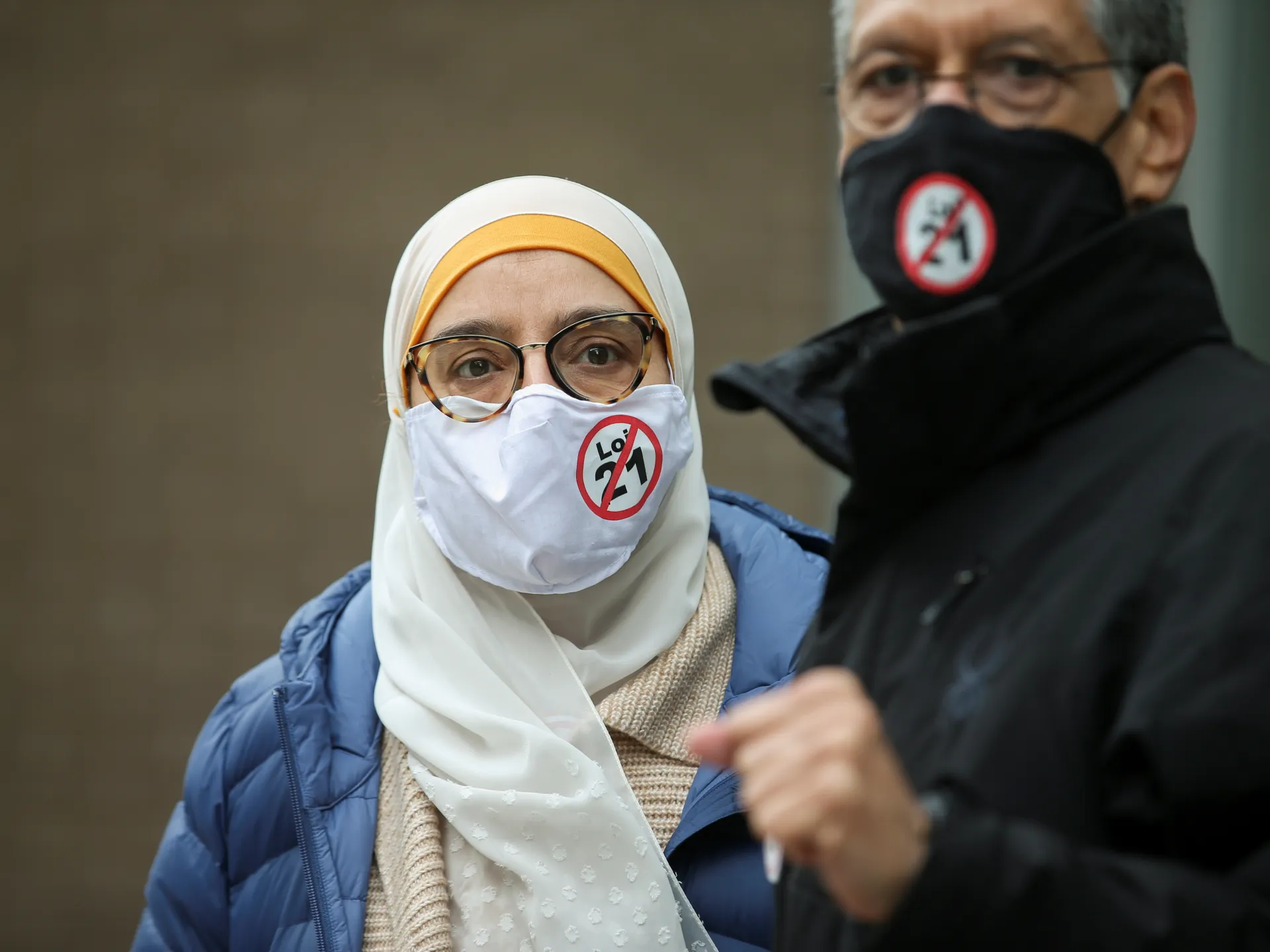
Canada’s Supreme Court is preparing to rule on a challenge to Bill 21, a Quebec law that prohibits public school teachers, police officers, and certain other public officials from wearing religious symbols while working. The upcoming landmark decision may clarify how far governments can go in using a provision of Canada’s Charter of Rights and Freedoms to shield laws from specific rights challenges. When Quebec enacted Bill 21 in 2019, it utilized the notwithstanding clause, which allows governments to maintain a law despite violations of certain protected rights, such as freedom of religion and equality. Although a Quebec court found in 2021 that the legislation infringed upon the rights of individuals wearing religious symbols, it upheld most of the law due to the notwithstanding clause. The Quebec Court of Appeal upheld that ruling in 2024, and the Supreme Court heard the case in March.
The legislation has disproportionately impacted Muslim women, particularly after expansions under subsequent bills like Bill 94 and Bill 9, which extended restrictions to school support staff, volunteers, daycare workers, and college and university policies. In a 2022-2023 survey for a report by the National Council of Canadian Muslims (NCCM) and researcher Nadia Hasan, 73 percent of 411 surveyed Muslim women stated the law affected their job searches, and 48 percent believed they were denied employment due to their religious identity. Furthermore, 88 percent of the surveyed Muslim women reported that the law made Quebec a less welcoming place to live. Stephen Brown, chief executive of the NCCM, stated that the legislation forces individuals to choose between their livelihoods and convictions, describing the situation as dehumanising and cruel.
Navien Waly, a 45-year-old resident born and raised in Canada, experienced the impact firsthand when she received an email stating she was no longer welcome to volunteer at her children’s schools because she wore a hijab. Waly, who began wearing the hijab four years prior at age 40, had previously volunteered at the schools for a decade. The law also halted her plans to transition from a finance career to work as a specialised educator, leaving her unable to practice the profession she trained for while wearing her religious head covering. Waly noted an increase in hostile encounters, including an incident at a grocery store where a man blamed immigrants for his ruined life, alongside strangers telling her to go back to her home.
When Bill 21 was introduced in 2019, the Quebec government framed it as a moderate approach to secularism stemming from the 1960s Quiet Revolution. Premier Francois Legault defended the legislation following its passage, stating that the majority felt ignored for years and that concessions were necessary to avoid extremes, while noting that religious symbols could still be worn in the street. Polling conducted prior to the law’s passage indicated that 64 percent of respondents in Quebec supported it. Conversely, opponents argue the law was politically motivated to gain votes by tapping into anti-Muslim sentiment and distrust of organized religion.
Groups including the NCCM, the Canadian Civil Liberties Association, and the World Sikh Organization are challenging the legislation, arguing it violates constitutional rights despite the notwithstanding clause. Brown stated that the council is asking the court to invalidate the use of the clause in this case, asserting it is meant to be an extraordinary power of last resort rather than a tool for governments to deliberately target citizens’ rights for political gain. Meanwhile, individuals affected by the law face difficult decisions regarding their futures, with Waly expressing uncertainty about her career path and noting that her oldest daughter is now weighing potential career aspirations against whether she chooses to wear the hijab.
SOURCE NAME: Al Jazeera English
Source: Al Jazeera English