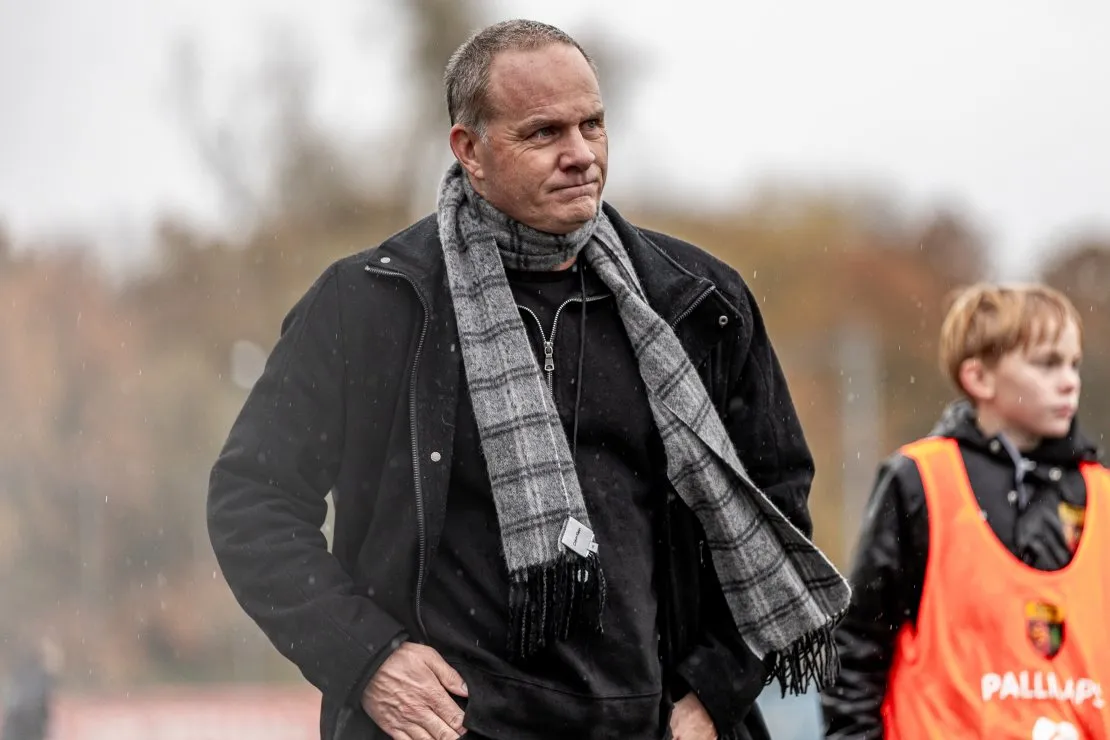
Eric Wynalda reveals that Nõmme United opted to pursue a different path following his brief two-month tenure as head coach, during which he successfully guided the squad to retain their position in the Premium Liiga. The American coach shared his perspectives regarding his exit and the wider landscape of Estonian football during an interview conducted with Baltic Football News.
Authored by Robin Hosman, the report details that Wynalda assumed the managerial role at Nõmme United on the 7th of September. However, the club informed him on the 11th of November that his services were no longer required. His brief tenure concluded after United guaranteed their top-flight status through a draw secured away against Kuressaare on the final matchday, successfully steering the team clear of the relegation play-offs.
The American manager clarified that his initial ties to Estonian football originated via his personal academy located in the United States, which primarily engages with players aged 16 and 17. Back in April 2026, he invited former Estonia international Mart Poom to New York subsequent to setting up an exhibition fixture against the academy of the New York Red Bulls.
Poom demonstrated considerable admiration for the young athletes, leading the pair to subsequently cultivate a professional relationship. Wynalda later journeyed to Estonia for the UEFA European Under-17 Championship, an event that simultaneously provided him with the chance to gain deeper insight into both Nõmme United and the broader scope of Estonian football.
Wynalda sought to implement a more proactive tactical philosophy at United, steering the squad away from a defensive methodology reliant primarily on counter-attacks. He held the conviction that the group possessed the capability to perform with heightened aggression, desiring his team members to press opponents actively, engage in one-on-one defending, and tackle every fixture devoid of fear.
His inaugural league fixture yielded a historic triumph over Kalju within the framework of the Nõmme derby. Wynalda noted that both the mental and tactical preparations were purposefully crafted to challenge the athletes within open-play scenarios, proving directly that they could hold their own against superior opponents.
Furthermore, he underscored the significance of deploying players in roles that maximised their individual capabilities, referencing Zakaria Beglarishvili as a prime illustration of this practice.
Nevertheless, his exit from the organization left him feeling dissatisfied regarding the manner in which the termination decision was communicated to him.
Wynalda expressed his astonishment, stating that after four days not a single message came from the owner, Ivar, to offer congratulations to him or the squad, or even to express gratitude for the two months of his life dedicated to keeping the club in the top division, noting instead that he received the news from a different individual.
He criticized the lack of professional courtesy, remarking that the owner lacked the class to call and inform him personally, and reiterated that Nõmme remains the sole club he could ever envision working with strictly because of Mart Poom, which served as the exclusive reason for his presence there.
Notwithstanding the difficult circumstances surrounding his exit, Wynalda maintains an optimistic outlook regarding the future potential of Estonia. He highlighted infrastructure as a primary obstacle facing the nation, pointing specifically to a scarcity of adequate stadiums and appropriate training facilities.
He offered praise concerning the standard found among several teams within the league, specifically mentioning FCI Levadia for boasting a robust squad, a competent manager, and a well-defined tactical philosophy. Additionally, he acknowledged the inherent qualities of Paide, Flora, Tammeka, and Harju, despite maintaining the conviction that numerous clubs lack the essential infrastructure required to function at a fully professional standard.
Wynalda drew parallels between this current environment and the state of soccer within the United States throughout the 1990s, an era when the sport remained detached from the mainstream and professional fixtures were occasionally staged on high school fields.
He also advocated for necessary reforms concerning the political structures and operational habits that he feels continue to hold back the progress of Estonian football.
In addressing retrospective criticism directed at his tactical approach while at Nõmme United, Wynalda clarified that varying adversaries necessitated distinct strategic adjustments. He conceded that the squad’s displays lacked consistent reliability, yet contended that the immediate objective remained securing survival in the division.
He elaborated that the task at hand was preserving league status, an objective demanding a precise skill set centered far more heavily on man management than traditional coaching, noting his belief that his coaching staff struggled within that specific dynamic.
Wynalda felt that players were receiving an excessive volume of instruction at a juncture demanding simplicity and self-assurance. While he commended the dedication of his coaching staff, he concluded that their methods misaligned with the pressing demands of the situation, given the severe time constraints.
He observed that a comprehensive pre-season period would have facilitated the introduction of a more intricate playing model alongside detailed tactical schemes. Given the prevailing conditions, however, his preference was to streamline instructions and empower players to leverage their primary strengths.
Ultimately, Wynalda is convinced that his tenure at the club successfully evidenced that the Nõmme United squad members possessed a higher level of capability than they had previously recognized.
He concluded by stating that his time there proved to the players that they are significantly better than they initially believed, pointing out that several of their match performances were truly exceptional.
SOURCE NAME: balticfootballnews.com
ORIGINAL HEADLINE: Eric Wynalda: ‘I still believe Estonia is a country with immense potential’
Source: balticfootballnews.com