Football clubs must consistently factor in business, communities, and competition. One of the most essential elements is establishing a sustainable and long-term strategy to ensure clubs can adequately serve the communities where they exist, which involves developing a sustainable business model. On the final day of May, exactly 8,308 spectators entered the gates in Kaunas to watch Kauno Žalgiris lose 0-1 against Žalgiris, marking the largest crowd recorded in Baltic league football for the season. Another 112,000 viewers watched that derby broadcast on television.
Five months later, on October 26, a mere 36 people attended a match between Grobiņa and Riga FC in the Latvian Virslīga. Despite this low stadium attendance, the visiting club was certainly not lacking an audience, as Riga FC boasts 129,300 followers on TikTok alone. Between those two contrasting figures lies the primary business story of Baltic football in 2026. Baltic Football News has conducted a comprehensive audit of all 29 top-flight clubs across the region based on four critical questions that sponsors, broadcasters, and investors typically ask first: How many people follow the club? How many people come to watch matches? How many commercial partners does the club list? And can an interested fan purchase any merchandise online?
The final result of this audit is clear. Lithuania’s TOPLYGA, which was rebranded from the A Lyga this year, successfully claims the top three positions in the commercial index. Meanwhile, Latvia holds the region’s largest digital audience yet features its emptiest shop window. Estonia sits directly between them, presenting a competition that is well organized and well stocked, but struggling significantly to draw a crowd into its stadiums.
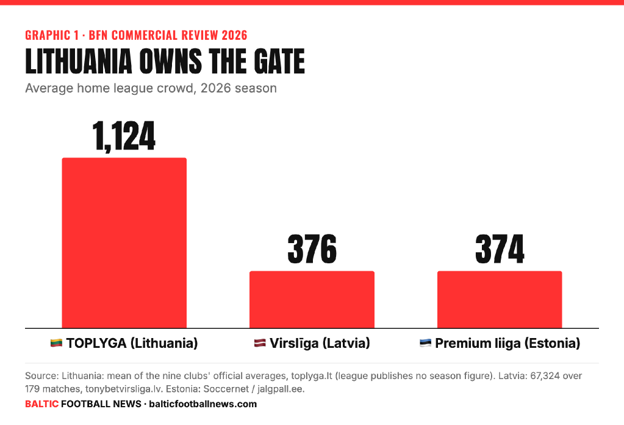
Looking at gate figures, Lithuania has pulled well ahead of its neighbors. TOPLYGA clubs managed an average of 1,124 attendees per game in 2026, whereas Latvia’s Virslīga averaged 376 spectators and Estonia’s Premium liiga averaged 374. This represents a three-to-one ratio, and the gap continues to widen over time. As recently as 2022, Lithuanian crowds averaged only 372 per match, though they climbed to 679 during the previous season. Conversely, Estonia’s average of 374 represents its lowest figure in four seasons, dropping down from 406 recorded in 2024.
Within Lithuania, Žalgiris led the entire Baltic region by drawing an average of 3,149 fans, which is almost four times their figure from 2025, driven by sales of more than 3,000 memberships before a single ball was kicked. Kauno Žalgiris followed closely, averaging 2,445 attendees, showing a massive increase from 319 in 2022. Additionally, Sūduva drew an average of 1,405 supporters. In total, four of the six best-attended clubs in the entire Baltic region play in Lithuania, giving TOPLYGA an average crowd size that is three times higher than either Latvia or Estonia.
Having a large stadium does not automatically translate to a large crowd. For instance, Kauno Žalgiris filled only 16 percent of their 15,026-capacity ground, whereas TransINVEST filled 66 percent of their 1,000-capacity venue. Meanwhile, Flora, which stands as Estonia’s best-supported club with an average of 579 attendees, utilized just 4 percent of the 14,336-seat A. Le Coq Arena, their primary home venue.
The digital screen audience has grown in tandem with physical stadium stands. Under the terms of a three-year broadcasting agreement with the LNK channel group, TOPLYGA reached a cumulative total of 744,000 viewers by June 4. During the opening weeks of the season, the average match audience on television stood at 81,600, representing a 27 percent increase compared to the 2025 figures.
When examining digital reach via mobile phones, if Lithuania excels at selling tickets, Latvia excels at securing digital reach. Virslīga clubs collectively hold 357,000 followers across Instagram, Facebook, TikTok, and YouTube. By comparison, TOPLYGA clubs maintain 297,000 followers, and Premium liiga clubs account for 205,000 followers. Nearly two-thirds of Latvia’s total digital audience belongs to a single organization. Riga FC commands 227,619 followers, which is more than double the audience of Žalgiris at 102,957, the next largest club in the region. Furthermore, Riga FC’s TikTok account alone is larger than the entire combined following of Žalgiris across four distinct platforms. In fact, Riga FC’s 129,300 TikTok followers almost equal the combined following of the other nine Virslīga clubs, which together total 129,627 followers.
Despite these figures, Riga FC remains an exception rather than the rule across the region. Only 10 out of the 29 audited clubs operate an official TikTok account. At the same time, 21 clubs maintain a presence on YouTube, 28 are active on Facebook, and all 29 clubs utilize Instagram. Estonia proves to be the most balanced digital participant, with five of its ten clubs utilizing TikTok and nine maintaining YouTube channels. In Lithuania, only two clubs operate on TikTok, and the larger account does not belong to Žalgiris, which has 10,600 followers, but rather to FA Šiauliai, which finished ninth in the standings and faced a relegation play-off, boasting 11,200 followers.
A follower does not automatically equate to a customer, nor does digital reach alone prove incoming revenue. Furthermore, the published data cannot definitively show whether Riga FC’s large audience actually converts into financial gains. However, to any commercial brand looking to purchase attention and visibility, these numbers are undeniably the most persuasive in the region.
Regarding commercial partnerships, each league is underwritten by a single title sponsor. Two of these are betting companies: TOPsport in Lithuania and Tonybet, which is now in its third operational year, in Latvia. Estonia’s title sponsor is the brewer A. Le Coq, whose naming rights deal dates back to 2013 and was extended for an additional five-year term in 2023. Betting money also flows heavily through the individual clubs. Betsson serves as the main sponsor for both Žalgiris and Kauno Žalgiris, while Coolbet backs Vaprus, FenixBet supports Harju, and Optibet appears on Flora’s shirts. Additionally, 7bet acts as a general sponsor for Džiugas, and Casino Admiral is listed among the lead sponsors for Šiauliai.
When counting the total number of commercial partners, Lithuania stands completely in a league of its own. Džiugas lists a staggering 76 partners, the vast majority of which are local businesses located in Telšiai. Šiauliai lists 57 partners, Žalgiris lists 54, and Sūduva lists 53. Across the eight Lithuanian clubs where partners could be counted, a total of 324 partners are listed. By contrast, the ten Virslīga clubs across Latvia list a combined total of only 59 partners—meaning Džiugas on its own lists more partners than the entire Latvian top flight combined.
Latvia’s partner pages are notably sparse. Auda’s official website states that their partner list is currently “being prepared,” while Super Nova’s partner page is completely empty. Tukums 2000 displays just a single logo, and Liepāja’s listed partner logos remarkably date back to 2018. Meanwhile, Riga FC lists 12 partners, and the reigning champions RFS list nine. Estonia’s club websites highlight a different issue entirely: significant unsold inventory. Flora’s primary main-sponsor slot remains empty, and at Nõmme Kalju, the main sponsor, shirt sponsor, and gold sponsor slots all display a “become a sponsor” placeholder.
A raw count of partners does not automatically equal monetary value, as a single shirt sponsorship deal can easily be worth more than fifty advertising boards at a local ground, and no club in the region publicly discloses the financial contributions of its partners. Nevertheless, this count clearly demonstrates how widely each club has cast its commercial net. Lithuanian clubs—six of which feature a city or district council among their lead partners—have cast their nets the widest.
Another critical finding is the availability of retail merchandise, or the lack thereof. Out of all 29 clubs, 19 sell merchandise online, either through their own dedicated web store or via an official retail partner. In Lithuania, eight out of nine clubs offer online purchasing. In Estonia, eight out of ten clubs do so. However, in Latvia, only three out of ten clubs provide online shopping options.
These deficiencies are not limited to the smallest clubs. For example, Liepāja has 22,153 followers yet features a fan-shop page listing merely ten items that can only be purchased at home matches, at a local barber shop in the city, or by email, with no online checkout mechanism. Banga, which commands 21,069 followers, sells its merchandise directly out of the club office located in Gargždai. Similarly, Auda, which finished third in the Virslīga and transferred player Josué Vergara to Gent for a reported fee of €3m, features a shop section that simply reads “coming soon.”
In total, nine clubs possessing a combined 101,721 followers have no online retail shop whatsoever, and seven of those nine clubs are based in Latvia. Where web shops do exist, their inventories vary widely. Riga FC’s store carries about 87 distinct products, including a specialized Conference League range and an €85 replica shirt. Žalgiris lists 79 products and Sūduva lists 63, whereas Levadia, Estonia’s reigning champions, sell approximately six items.
Combining all four measured categories—weighted equally and scored against all 29 clubs—the Baltic Football News commercial index establishes a definitive top ten ranking. Lithuania successfully secures the top three positions and claims five spots within the overall top ten. The nine TOPLYGA clubs achieve an average index score of 76, while Estonia’s ten clubs average 57, and Latvia’s ten clubs average 31. Furthermore, eight out of the bottom ten clubs in the index are Latvian.
Every single club appearing in the commercial top ten offers online shopping. Conversely, among the nine clubs that lack an online shop, none manages to score above 53 on the index. Notably, the commercial index does not mirror the traditional athletic league table. Kauno Žalgiris, who finished as league champions and treble winners, rank second overall. RFS, Latvia’s league champions, rank eighth, and Levadia sits in ninth place. Auda, who finished third on the athletic pitch, scores a low 21, while Daugavpils, participating in European competition for only the second time, scores 17.
European qualification brings substantial financial rewards that the commercial index does not measure. Kauno Žalgiris reached the league phase of the Conference League, an achievement estimated by Baltic Football News to be worth approximately €3.9m, and Riga FC reached that stage for the first time as well. However, European income cannot be reliably depended upon every single summer, whereas memberships, merchandise sales, and commercial partners can be consistently built upon year after year.
Looking toward future actions for improvement, Latvia must open its retail till. Seven Virslīga clubs currently lack an online checkout system, including notable names like Liepāja with 22,153 followers and Auda with 17,170 followers. Implementing a simple web store, or utilizing a retail partner of the kind already used by TransINVEST, Vaprus, and RFS, would quickly close this gap. Latvian clubs also need to publish their partner pages, as Auda, Super Nova, and Tukums 2000 currently display between zero and one partner, and a sponsor cannot buy what a club fails to display. Additionally, these clubs should sell their empty inventory slots, and start official TikTok accounts, given that 19 of the 29 clubs currently have none, with Riga FC demonstrating the ceiling of success and Šiauliai demonstrating with 11,200 followers that a massive club size is not required to succeed on the platform.
For Estonia, the primary focus must be fixing stadium attendance. At an average of 374 spectators, the Premium liiga’s crowd size is at its lowest point in four seasons. Conversely, observers should watch Vilnius closely, where Žalgiris anticipates home crowds ranging from 7,000 to 10,000 spectators once the new National Stadium is constructed, according to reporting by Baltic Football News, alongside TOPLYGA returning to a ten-club format in 2027.
To explain the methodology, follower metrics were recorded on November 9, 2026, from each individual club’s official Instagram, Facebook, TikTok, and YouTube accounts. Instagram rounds follower counts exceeding 10,000, and YouTube rounds counts exceeding 1,000, while X was completely excluded from the study because follower counts are not publicly readable. Average crowds represent official 2026 home league figures gathered from toplyga.lt, tonybetvirsliga.lv, and jalgpall.ee. Lithuania’s league average of 1,124 represents the mathematical mean of the nine clubs’ official averages, as the league itself does not publish an official season-wide figure, while Estonia’s figure of 374 is taken from Soccernet data. Stadium capacity is defined as each club’s primary home venue. Partner counts reflect the number of listed partners displayed directly on each club’s official website on November 9, measuring breadth rather than financial value. The index gives equal weight to followers, average crowds, and listed partners—scored as percentiles against all 29 clubs—alongside a binary yes/no metric for the presence of an online shop, with any missing measure left out rather than scored as zero. Kauno Žalgiris’s partner page blocked access, meaning their score utilizes three measures, while Nõmme United lacks an official website so their social accounts were matched by name, and their partners and shop status could not be confirmed, resulting in them being counted as having no online shop. These figures describe the public commercial footprint of the clubs, do not indicate revenue or profit, and none of the outlined links should be interpreted as direct cause and effect.
SOURCE NAME: balticfootballnews.com
ORIGINAL HEADLINE: Lithuania wins the Baltic money league as Latvia keeps its shop doors shut
Source: balticfootballnews.com