On Thursday, the Bank of Korea (BOK) increased its key interest rate by 0.25 percent, bringing it to 3.25 percent. The central bank cited strong domestic growth and above-target inflation as the reasons for the hike, which occurs as high demand for computer chips drives one of the Asian economy’s fastest expansions in more than a decade. According to the BOK, the global economy is anticipated to sustain a favorable growth trend because of robust artificial intelligence investment, despite ongoing tensions in the Middle East.
South Korea recorded an inflation rate of 2.8 percent in October, which exceeds the central bank’s target of 2 percent. The BOK stated that inflation is projected to remain elevated for a period due to the fallout from higher energy prices. Looking forward, the central bank noted that financial markets and the global economy will be influenced by the artificial intelligence investment outlook, developments in the Middle East, and shifts in monetary and fiscal policies across major economies.
Driven by expectations of continued growth in investment and exports, the BOK adjusted its gross domestic product growth forecasts. The central bank raised its 2026 forecast to 3.9 percent and its 2027 forecast to 4.1 percent. Previously, in August, the BOK had projected growth of 3.3 percent for the year and 2.9 percent for 2027. South Korea’s gross domestic product grew by 3.4 percent year-on-year in the July-September quarter, exceeding forecasts. Excluding the COVID-19 pandemic outlier years, Asia’s fourth-largest economy is heading toward its strongest performance since 2010, when growth reached 6.2 percent.
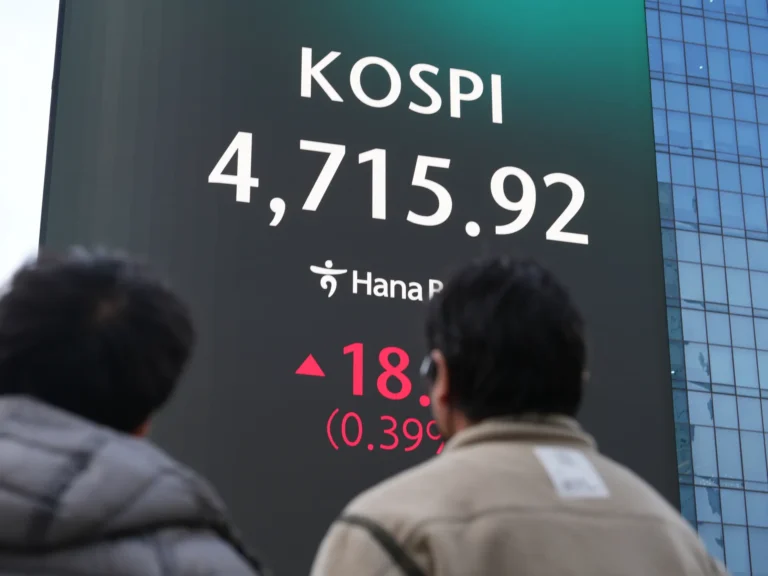
South Korea hosts top memory chip manufacturers Samsung Electronics and SK Hynix, positioning the nation as a primary beneficiary of the multi-trillion-dollar artificial intelligence investment boom. In October, the country’s exports increased by 94 percent year-on-year to $115.3bn, following a record monthly total of $120.9bn in September. Counterpoint Research reports that semiconductors made up nearly half of all exports, led by Samsung Electronics and SK Hynix, which jointly control roughly 80 percent of the global high-bandwidth memory market and 60 percent of the dynamic random-access memory market. Following a tech-led sell-off the prior day, South Korea’s stock market increased alongside a regional equities rebound, with Seoul’s Kospi rising 1.7 percent by 05:15 GMT on Thursday.
SOURCE NAME: Al Jazeera English
Source: Al Jazeera English